
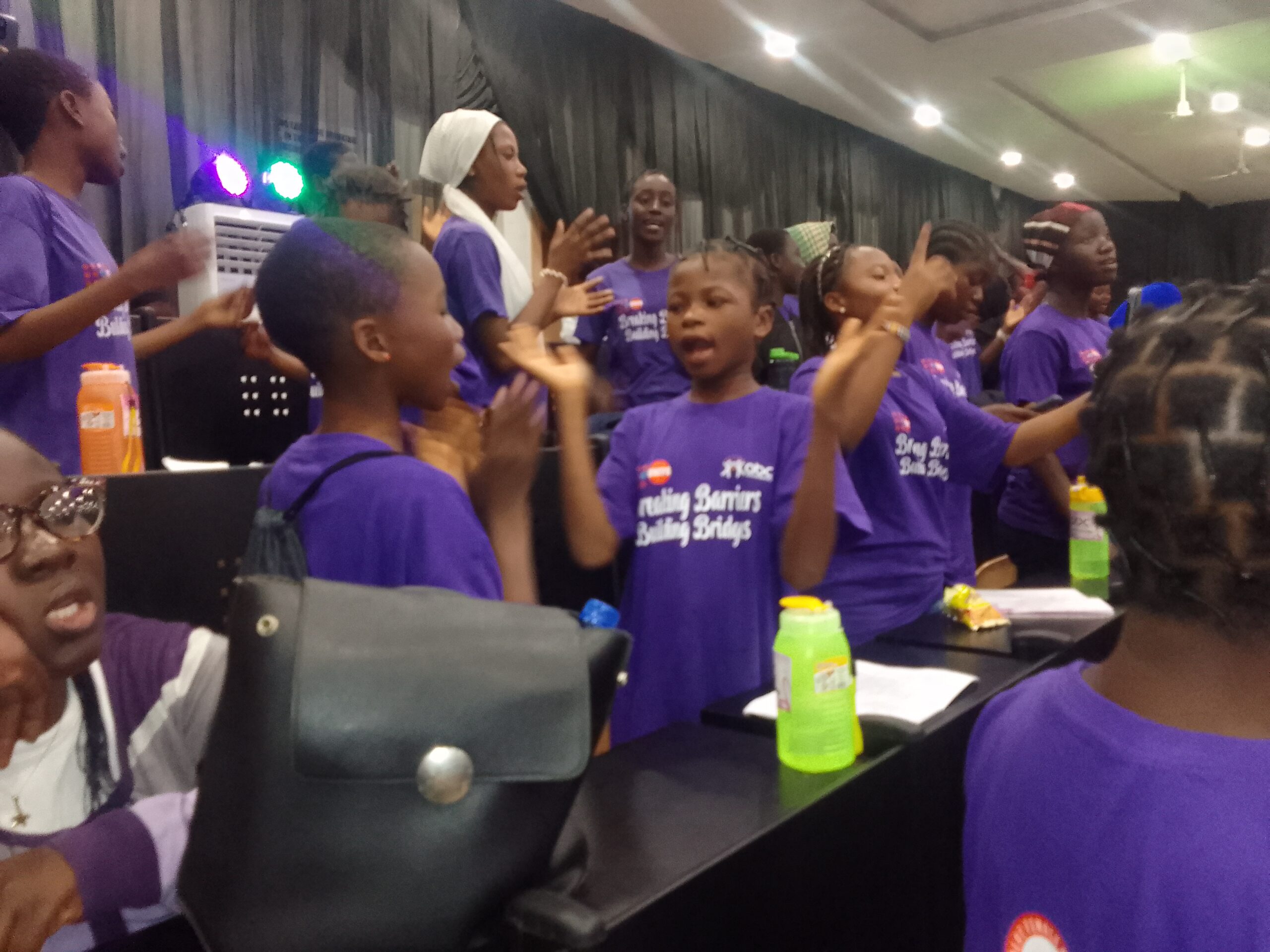
HURRAY!
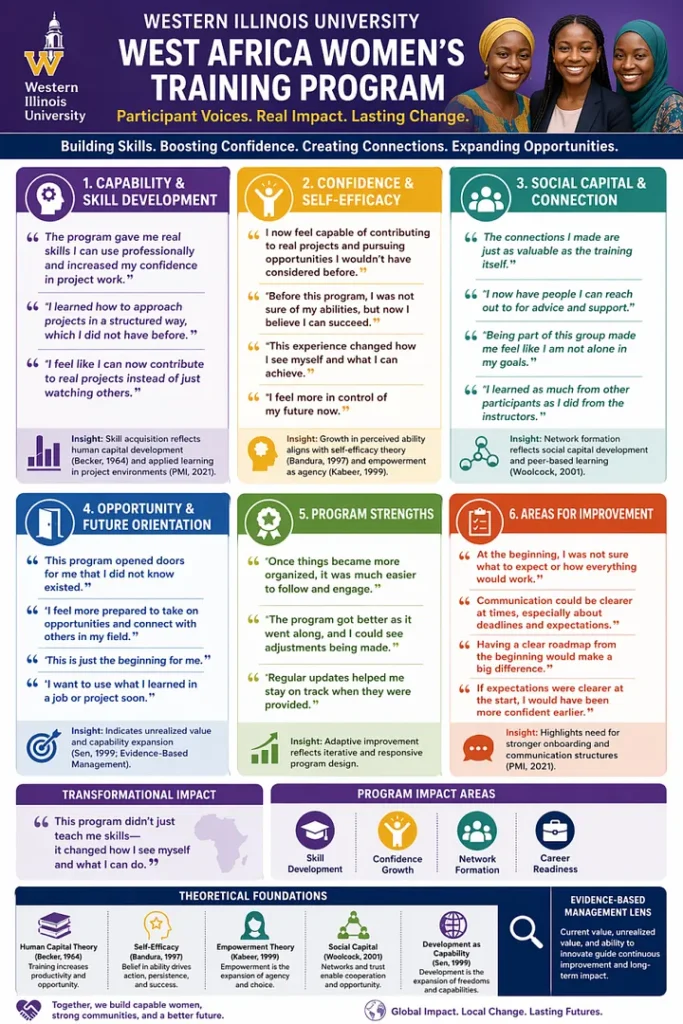
WIWa Voices as Capability & Connection: Evaluation of the Western Illinois University West Africa Women’s Training Program Through Interviews
By: WiWa Project Team
Abstract
This report evaluates the Western Illinois University West Africa Women’s Training Program through participant experience, development theory, and an evidence-based management framework. Drawing on participant reflections, it shows how the program builds practical skills, strengthens confidence, and develops professional networks, enabling participants to apply structured project knowledge and engage more actively in opportunities.
The analysis identifies strong current value in skill acquisition and self-efficacy, while also highlighting unrealized value in participants’ aspirations for employment and continued learning.
Feedback points to areas for improvement in onboarding and communication, alongside evidence of adaptive program refinement over time.
Overall, the program expands capability, agency, and access to opportunity, and its impact can grow further through stronger structural alignment and connections to real-world pathways.
Introduction
This report evaluates the WiWa (Western Illinois University West Africa) Women’s Training Program through participant experience, development theory, and an evidence-based management perspective.
We examine how the program builds capability, strengthens confidence, and expands networks while identifying design improvements.
Participant voices serve as the primary evidence, and the analysis interprets these experiences through scholarship on empowerment, project management, and social capital.
The report then assesses outcomes using an evidence-based management framework to examine value creation, unrealized potential, and opportunities for refinement.
Participant Experience & Skill Development
Participants report gaining practical, transferable skills. One participant stated, “
“The program gave me real skills I can use professionally and increased my confidence in project work.”
Another explained,
“I learned how to approach projects in a structured way, which I did not have before.”
A third noted,
“This training helped me understand how work is organized in professional environments.”
These responses show a shift from informal exposure to structured knowledge.
Becker (1964) defines this process as human capital development, where training increases productivity and opportunity.
The emphasis on structured approaches aligns with project management research, which highlights the importance of defined processes and clarity in execution (Project Management Institute, 2021).
Participants do more than observe these structures; they apply them.
One reflected,
“I feel like I can now contribute to real projects instead of just watching others.”
This demonstrates active learning.
It supports Sen’s (1999) argument that development expands an individual’s ability to act on opportunities.
Confidence & Self-Efficacy
Participants consistently describe increased confidence.
One stated,
“I now feel capable of contributing to real projects and pursuing opportunities I wouldn’t have considered before.”
Another explained,
“Before this program, I was not sure of my abilities, but now I believe I can succeed in a professional setting.”
A third shared,
“This experience changed how I see myself and what I can achieve.”
These responses reflect Bandura’s (1997) concept of self-efficacy, or belief in one’s ability to perform tasks and achieve goals.
As self-efficacy increases, individuals engage more readily with challenges and persist through difficulty. Participant responses indicate that the program drives this shift.
Kabeer (1999) defines empowerment as the expansion of agency.
Participants describe this change in concrete terms. One stated,
“I feel more in control of my future now.”
This reflects movement from constraint toward choice, a central element of empowerment.
Social Capital & Network Formation
Participants emphasize the value of relationships formed during the program.
One stated,
“The connections I made are just as valuable as the training itself.”
Another explained,
“I now have people I can reach out to for advice and support.”
A third shared,
“Being part of this group made me feel like I am not alone in my goals.”
These responses demonstrate the formation of social capital, which Woolcock (2001) defines as networks that enable cooperation and opportunity.
The program builds both bonding capital among participants and bridging capital across contexts.
Peer learning plays a key role.
One participant noted,
“I learned as much from other participants as I did from the instructors.”
This highlights how shared experience contributes to value creation.
Social capital strengthens human capital by expanding access to knowledge and support.
Program Delivery & Project Management Considerations
Participants recognize the program’s value while identifying areas for improvement.
One stated,
“At the beginning, I was not sure what to expect or how everything would work.”
Another noted,
“Communication could be clearer at times, especially about deadlines and expectations.”
A third explained,
“Once things became more organized, it was much easier to follow and engage.”
Get Dr Casey LaFrance’s stories in your inbox
Join Medium for free to get updates from this writer.Subscribe
Remember me for faster sign in
These responses point to gaps in communication and onboarding.
The Project Management Institute (2021) emphasizes that clear expectations and consistent communication drive successful delivery. Early uncertainty suggests a need to strengthen initial program structure.
At the same time, participants observe improvement.
One stated,
“The program got better as it went along, and I could see adjustments being made.”
This reflects adaptive management, where teams respond to feedback and refine delivery over time.
Women’s Development & Program Impact
The program advances key dimensions of women’s development.
Participants report gains in skills, confidence, and networks, all of which support empowerment.
The World Bank (2012) finds that programs achieve stronger outcomes when they combine skill development with access to networks and opportunities.
Participant responses support this model.
One stated, “
“This program opened doors for me that I did not know existed.”
Another explained,
“I feel more prepared to take on opportunities and connect with others in my field.”
These responses show that the program strengthens both capability and access.
Kabeer (2005) identifies empowerment as the interaction of resources, agency, and achievements.
Participants describe all three: skills provide resources, confidence strengthens agency, and new opportunities signal achievement.
Evaluation Through an Evidence-Based Management Lens
The analysis applies an evidence-based management framework drawn from Agile and organizational performance literature.
This framework evaluates current value, unrealized value, and the capacity to innovate.
Participants express strong current value.
Statements such as
“This program gave me real skills I can use professionally”
and
“I feel more confident in my abilities”
reflect immediate benefits in knowledge and self-perception.
Participants also describe unrealized value through future aspirations.
One stated,
“I want to continue learning and apply these skills in a real job.”
Another explained,
“This is just the beginning for me.”
These responses show that the program creates pathways beyond its duration.
Strengthening connections to employment and continued learning would help realize this potential.
The program demonstrates an ability to innovate through responsiveness to feedback.
One participant noted,
“I could see that changes were made based on what we said.”
This reflects a learning system that adapts rather than follows a fixed design.
At the same time, process gaps limit value. Early confusion and inconsistent communication reduce participant confidence.
One stated,
“If the expectations were clearer at the start, I would have been more confident earlier.”
Addressing these issues would increase overall impact.
Lessons Learned & Future Considerations
Participant feedback highlights clear areas for improvement. Strong onboarding supports early confidence and engagement.
One participant stated,
“Having a clear roadmap from the beginning would make a big difference.”
Consistent communication sustains engagement.
A participant noted,
“Regular updates helped me stay on track when they were provided.”
This aligns with project management research that identifies communication as a core success factor (Project Management Institute, 2021).
Participants also emphasize the importance of relationships.
One explained,
“The relationships I built will stay with me beyond the program.”
This shows that social capital drives value, not just supports it.
Finally, participants want opportunities to apply their skills.
One stated,
“I want to use what I learned in a job or project soon.”
Strengthening links to employment and real-world projects would extend program impact.
Conclusion
The Western Illinois University West Africa Women’s Training Program produces measurable gains in skills, confidence, and relationships. These outcomes align with established theories of human capital, empowerment, and social capital.
An evidence-based management perspective shows both strong current value and significant future potential. Participants benefit immediately while identifying pathways for continued growth. Addressing structural gaps and strengthening external connections would expand the program’s impact.
One participant summarized the experience:
“This program didn’t just teach me skills, it changed how I see myself and what I can do.”
That
reflects the program’s broader contribution. It expands capability and agency in ways that extend beyond technical training.
Continued refinement will strengthen its role as a sustainable model for workforce development.
WIWa Voices as Capability & Connection: Evaluation of the Western Illinois University West Africa Women’s Training Program Through Interviews | by Dr Casey LaFrance